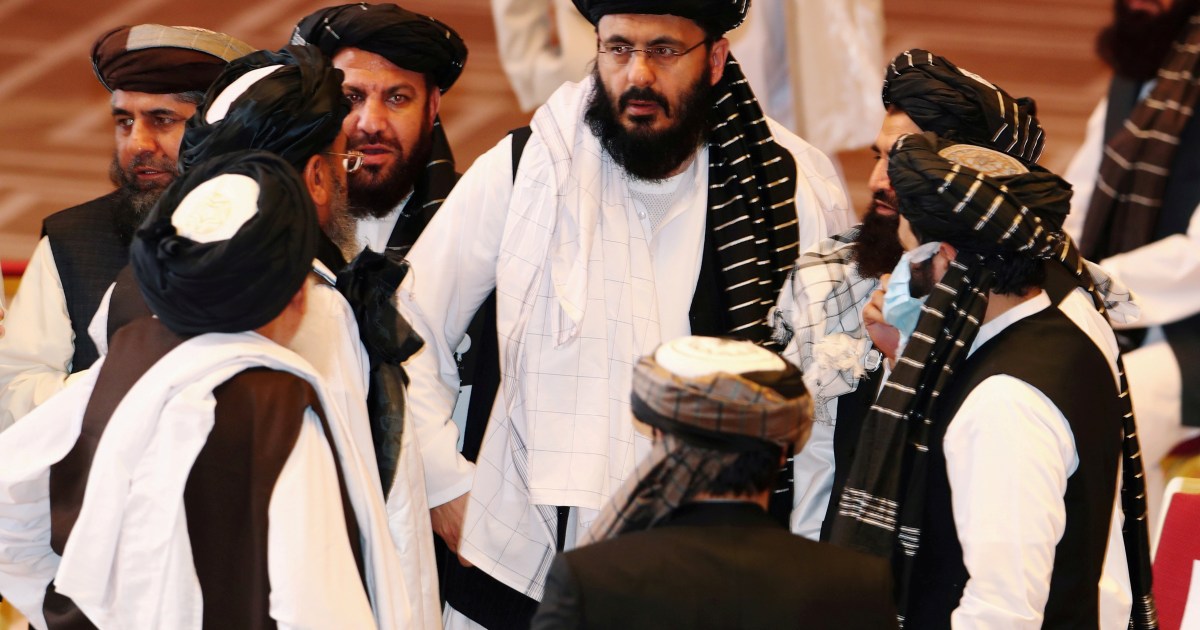
The Afghan government delegation and the Taliban have said they will meet again and have instructed to expedite their peace talks after two days of inconclusive talks in Doha, Al Jazeera has learned.
Negotiators from rival parties, which have been in Doha since Saturday, said in a joint statement that “the two sides have pledged to continue negotiations at a high level until an agreement is reached.”
“We will work to provide humanitarian aid throughout Afghanistan,” the statement added.
According to Doha reports, Al Jazeera’s Osama bin Javaid said: “The two sides presented a hotly contested draft where they finally agreed to talk and speed up talks. They agreed that the level of negotiations would be accelerated.”
Javaid added that, however, the details were not discussed.
It falls short
For months, the two sides have met intermittently in the Qatari capital, but have achieved little or no notable success. The talks seem to have lost strength, as Taliban fighters have made huge gains on the battlefield.
Senior representatives of the Kabul government, including the head of the High Council for National Reconciliation, Abdullah Abdullah, flew over two days of intensive talks as U.S. forces are about to complete the withdrawal of their troops.
Ahead of the second day of talks, the Taliban’s supreme leader, Haibatullah Akhundzada, had said that “the Islamic emirate is strongly in favor of a political agreement” despite the groups gaining ground on the ground.
But the facilitator of the talks in Qatar said at the end of the two days that the parties had only agreed to “work to avoid civilian casualties”, far removed from the previously agreed ceasefires.
“The two sides agreed to continue negotiations at a high level until an agreement is reached. To that end, they will meet again next week,” said Mutlaq al-Qahtani, Qatar’s counterterrorism envoy. oversees Doha talks.
Complex military campaigns
Taliban leader Akhundzada has said his group remains committed to forging a solution to end the war, but has criticized the group’s opponents for “wasting time”.
The Taliban took advantage of the final stages of the withdrawal of U.S. and other foreign troops from Afghanistan to launch a series of lightning strikes across the country.
The group is now believed to control about half of the nation’s 400 districts, several major border crossings and has laid siege to a number of vital provincial capitals.
A spokesman for the Afghan security forces said pro-government fighters had carried out 244 operations, killing 967 “enemy” fighters, including key commanders.
“So far we have recovered 24 districts, our goal is to recover all the territories … We are ready to defend our country,” Ajmal Omar Shinwari told reporters.
The Taliban have seemed to be united for a long time, operating under an effective chain of command and conducting complex military campaigns despite perennial rumors of splits within their leadership.
But questions remain about the control Taliban leaders have over commanders on the ground and whether they will be able to convince them to comply with a potential agreement if it is signed.
Despite the next few days before the Eid holiday, the Taliban leader’s statement made no mention of a formal call for a ceasefire.
Over the years, the Taliban have announced a series of brief truces during Islamic holidays, initially spurring a greater reduction in violence. However, the group has been criticized for using the temporary ceasefire to resupply and bolster its fighters, which has allowed them to launch offensive blows at Afghan security forces once the truce ends.
Speaking from Washington, DC, Al Jazeera’s Rosalind Jordan said: “The American understanding has always been that something of this magnitude to reach a global peace agreement between the Taliban and the government of Civilian-run Kabul will take time and it will be difficult, so you see all these rounds of repeated talks. “
He added that although US troops left Afghanistan earlier this month, the country remained a major foreign policy issue for the United States.
“When it comes to the short-term foreign policy of the United States, it is still very concerned and Afghanistan is a central part,” he explained, adding that U.S. delegations have been visiting neighboring countries to talk about ways. they can help Afghanistan prosper and move away from the prospects of civil war.
The U.S.-led military coalition has been on the ground in Afghanistan for nearly two decades after an invasion launched after the September 11, 2001 attacks.
Fears are growing that Afghan forces will be overwhelmed without vital coalition air support, allowing for a full Taliban military takeover or the start of a multilateral civil war for a country flooded with weapons after nearly four decades. of fighting.