The FAR Part 91 sector of aviation has long enjoyed an admirable safety record. Business aviation has always been perceived as a very safe and efficient way to fly.
But much has happened in the world over the last few years that has impacted business aviation. Significant among the changes is a decrease in engagement caused by the downturn in flying during COVID and the outflow of talent to the airlines.
So, what has been the impact of recent world events on business aviation, especially as it relates to safety? And what is the current state of safety in the business aviation industry sector? To get the latest perspective, we asked a randomly selected group of 19 current directors of aviation in the business aviation sector what they thought. Their answers to key questions are below.
What is the level of engagement with the SMS within your flight department?
This question sought visibility into how well the Safety Management System (SMS) is embedded within the flight department by functional group. The highest level of engagement was from flight operations, likely due to the pilot-centric focus of the registration standards. Lower levels of engagement were experienced from the Maintenance and Scheduling functional groups.
Is your SMS proactive and effective?
Here we probed how effective each aviation director thought their SMS is at finding and adequately addressing safety concerns.
Many of them who answered “yes” to this question at the same time expressed some degree of reservation about the effectiveness of their SMS. These reservations included complacency and low utilization, therefore causing the overall effectiveness of the SMS to be below the level to which the department aspires.
Another factor behind the high degree of affirmative responses could be the reluctance to acknowledge that their SMS is not as effective as it should be, especially given the level of effort that went into its establishment.
What are the barriers to SMS implementation?
According to respondents, the primary barriers reported to be in the way of effective SMS implementation are as follows:
- Complacency toward use of SMS
- Lack of trust in the ‘Just Culture’
- Non-uniform SMS deployment
- Workload
- Excessive time horizon to spot trends in Part 91 operations
- Safety as a collateral duty vs. full-time position
- Administrative burden in escalation of “the smaller stuff”
What are the most significant safety concerns in Part 91 Today?
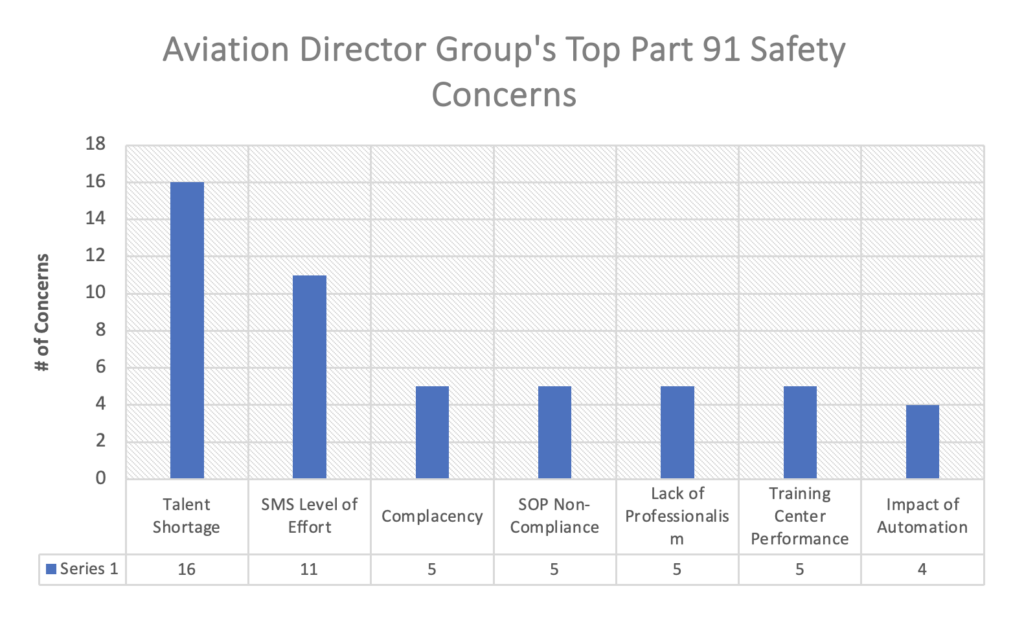
This is the most alarming part of the survey feedback. The responses to this question came back largely in freeform style, but when nominally grouped, here’s what the aviation directors told us are their primary concerns about safety in the Part 91 world today.

Talent Shortage
The most significant safety concern in Part 91 operations noted was the talent shortage, particularly the airlines hiring experience away. It is becoming increasingly difficult to replace the pilots who are leaving with an equivalent level of expertise. Higher rates of attrition are seen to risk cohesiveness within the flight department, introducing elevated levels of risk even with high standards, strong processes, and well-defined procedures in place.
The departure of highly experienced labor in an ever-tightening labor pool has resulted in less experience across the entire aviation system (ATC, flight operations, technical operations, ground handling, etc.). The belief is that the talent shortage is a factor in higher incident rates and increased stress on what was an already overstressed system.
SMS Level of Effort
This was the second most critical safety concern expressed, belief that the benefits of an SMS do not outweigh the efforts required for its establishment.
Complacency
Complacency and a lack of focus on the fundamentals was noted both in the flight department and in the oversight of external vendors and service providers.
SOP Non-Compliance
Alarmingly, many respondents cited a lack of strict adherence to stated standards and enforcement of them.
Lack of Professionalism
Many noted a lack of the pursuit of excellence or continuous improvement.
Training Center Performance
Virtually everyone indicated that the quality of training within the industry has declined.
Impact of Automation
The increasing complexity of operations in aircraft technology and the mission and range of international operations was noted as a significant safety concern.
Is It Time for a Wake-Up Call?
Three of the top seven safety concerns—Complacency, SOP Non-Compliance, and Lack of Professionalism—have plagued business aviation for decades. Any of them could cause a serious incident or accident.
They are all attitudinal in nature and they are all preventable. We need to stop the “race to minimum criteria,” and instill the pursuit of excellence into business aviation. We need to knock these three concerns off the list once and for all.
Where Do We Go From Here?
There is nothing more important in aviation—business aviation or otherwise—than to continuously improve the level of safety.
Nothing less than a full-court press is required to get these attitudinal threats to safety off the list. Do we have the courage to do so?
Resources
Read the full study results.
© 2024 Gray Stone Advisors. All Rights Reserved.
The FAR Part 91 sector of aviation has generally been safe, but recent world events have influenced business aviation. Factors such as decreased engagement due to COVID and talent outflow to airlines are impacting safety. A survey of 19 aviation directors revealed concerns about SMS engagement, effectiveness, barriers to implementation, and safety concerns in Part 91 operations. Key worries include talent shortage, SMS level of effort, complacency, SOP non-compliance, lack of professionalism, declining training quality, and the impact of automation. To enhance safety, a shift towards excellence and continuous improvement is necessary to address attitudinal threats in the aviation industry.
Source link